Archiv rubriky: Nezařazené

OER community released the Foundations for OER Strategy Development

Last week, the OER community released the Foundations for OER Strategy Development. This document provides a concise analysis of where the global OER movement currently stands: what the common threads are, where the greatest opportunities and challenges lie, and how we can more effectively work together as a community. Ideas for this document came from across the OER community, following a 6-month drafting and feedback process. The document can be found at http://oerstrategy.org

This document reflects the state of the OER movement through the eyes of its practitioners: what we need as a movement, what we agree on, areas where we differ, and opportunities for advancing OER globally. The Cape Town and Paris Declarations set the vision for the OER movement, including the value statements that form the basis for our work. We see the Foundations for OER Strategy Development as forming the basis for future actions and commitments.

Our next step is to make the commitments for actions that will continue the momentum.

Make a commitment to advance OER:

  1. Read the document.
  2. What actions will you take? Consider:

– How will you address the opportunities and challenges outlined?
– What do you see as the greatest opportunity and what ideas do you have to address it?
– How can your organization work effectively with others to address this?
– What roles are you best suited to take?

  1. Make your commitment public.

– Tweet your commitment using the hashtag #oerstrategy.
– Follow the conversation … we’ll also capture the tweets at oerstrategy.org

  1. Get to work and keep us updated.

– Tweet your updates using #oerstrategy.
– Let’s track our collective progress and build an even stronger global OER community.

Thank you for helping to build the open future of education!

Foundations for OER Strategy Development drafting committee: Nicole Allen, Delia Browne, Mary Lou Forward, Cable Green, Alek Tarkowski.

Alek Tarkowski


Papers awarded with 2015 ICDE Prizes for innovation & best practice in open and distance education

Open Praxis vol 7 no 4 was launched today and includes the papers awarded with 2015 ICDE Prizes for innovation & best practice in open and distance education http://www.openpraxis.org/index.php/OpenPraxis/issue/view/20/showToc
Also it comes with 3 research papers

Martin Weller, Bea de los Arcos, Rob Farrow, Beck Pitt, Patrick McAndrew: The Impact of OER on Teaching and Learning Practice

Manuel Flores Fahara, Armida Lozano Castro: Teaching Strategies to Promote Immediacy in Online Graduate Courses

Javiera Atenas, Leo Havemann, Ernesto Priego: Open Data as Open Educational Resources: Towards Transversal Skills and Global Citizenship

Dr. Javiera Atenas

HEA Fellow

UCL School of Management 

Gower St, London, WC1E 6BT

London

New free eBook on Future Internet technologies

We are pleased to announce that we have launched a free eBook on Future Internet technologies developed within the EU project FORGE (http://ict-forge.eu/).

This is a fully interactive eBook for iOS and MacOS. It introduces a range of Future Internet topics using FIRE (http://www.ict-fire.eu/) facilities. Readers have the opportunity to study in depth various aspects of networking protocols and infrastructure, watch instructional movies and screencasts, as well as conduct experiments using the FIRE infrastructure.

The eBook content is licensed under CC-BY 4.0.

Download it here: https://itunes.apple.com/us/book/id1062612920

Dr Alexander Mikroyannidis
Knowledge Media Institute, The Open University, UK
http://kmi.open.ac.uk/people/member/alexander-mikroyannidis

— The Open University is incorporated by Royal Charter (RC 000391), an exempt charity in England & Wales and a charity registered in Scotland (SC 038302). The Open University is authorised and regulated by the Financial Conduct Authority.

The Organization for Economic Cooperation and Development (OECD) released its latest OER report

The Organization for Economic Cooperation and Development (OECD) released its latest OER report
yesterday:

This report is a welcome contribution to overall OER strategy and open licensing policy recommendations to governments; and will be helpful in educating national governments, policy markers and educators about the benefits of OER specifically and open education more generally.

Congratulations OECD!

Cable Green

Minutes of the third annual Brussels Meeting of the EU Policy Advocacy Group

from: https://meta.wikimedia.org/wiki/EU_policy/Big_Fat_Brussels_Meeting_-_Episode_3/minutes

Minutes of the third annual Brussels Meeting of the EU Policy Advocacy Group

present:
User:Nicole Ebber (WMDE), User:Laurentius, User:Effeietsanders, User:Theredmonkey User:Dimi_z, User:Romaine,User:SPQRobin, User:Aktron, User:Michael Jahn WMDE, User:Pseudacorus, User:Myriam WMFr, User:Wendy the Weasel,User:Oop, User:Mtmlan84, User: Simon Hampton, User: Stuart Prior (WMUK), User:John Andersson (WMSE)

Big Fat Brussels Meeting 2015 - Day 1 (4).jpg

20 November – Friday

Introduction
Somewhat embarrassing. We believe everyone that they are who they say they are.

History

  • First meeting on EU Policy way back in 2009 -> no concrete outcomes
  • First Big Fat Brussels Meeting in 2013 -> three concrete goals and designated „contact person“
  • We gradually increased out intentions on what we can and can’t do.
    • First a discussion if we should do anything at all
    • Then which issues everybody in Wikimedia could agree on
    • then we worked on a number of larger issues that are relevant, and could be localised from country to country.
  • Dimi is working on it now full time, and storms Brussels on a daily basis.
  • Today: What are the topics that we want to focus on in European policy arena for the next few years?

General Discussion

  • We should somehow select from the relevant topics which we would like to focus on and can be successful with
  • It has to be on the list for the European Commission, but also needs sufficient support of people in the Member States, so that they can work together with Dimi on it!

Access

Access to knowledge

  • Technological (internet, library, material, books), Financial (afford), Legal (copyright, open

access, free licenses)

  • In several countries and in Wikisource people are working on ‚open access‘.
  • Very broad topic, what should we include here? OER? Free software?

Big Fat Brussels Meeting 2015 - Day 1 - Sheet 1.jpg

What is going on in EU right now:

  • In EU, Horizon2020 (research funds) now requires that funded works are in open access. However, there are still a few issues:
    • the Commission has not defined what „open access“ is
    • a 12-month embargo is allowed;
    • unfortunately, journals with hight impact factor are often not open access
  • Public Sector Information Directive:
  • Telecoms Package: finalized.
    • It might end roaming Europe in a few years
    • Zero-rating will be permitted (hence, no full net neutrality and WP:0 allowed)

Brainstorming: what matters for us?

  • internet access (in refugee camps) – risky topic, given net neutrality discussions. Maybe not the best topic to work on

inside Europe.

  • open educational resources (see below)
  • free/libre open source software (FLOSS) – lobby issues could include the use of software by government, or the file

formats. Governments buy applications, not libraries. Maybe we could do something on interoperability?

  • open access and its definition; scientific knowledge/research publications
    • pro: Wikipedia is a user case for open access (both editors and readers. Citations are useless if behind a paywall).
    • We are a credible player on this. National & international discussions could strengthen each other. it is ON the agenda!
    • cons: already many players on this; not really related to us.
  • digitization – not so much an access problem for Europe (see copyright).
  • government data (see below). Similar to open access.
  • internet/computer literacy – important, but maybe not the first thing on the agenda in Europe
  • accessibility (e.g., for blind, low-sighted, people with disabilities)
    • the Marrakesh treaty is introducing a new copyright exception for some parts of this.
    • possible to use our name to highlight the importance of technical accessibility to information (especially from

authorities, but also from companies and other organizations etc.)

    • associations of blind people are in a better position to work on this

So the most important topics are:

  • open access
  • interoperability (file formats, software, operating systems, online ecosystems etc.)

General point:
What is being produced / paid for by the government, should be accessible by the general public. This goes for access to government information, this goes for data, for educational resources. Freely accessible is the very minimum, free licenses are the next step. (government including all institutions paid for by public money). The question is on which issues we take the first stance.

Copyright

We agree that copyright is the most important issue to take up now.
We are trying a new way of brainstorming/mapping our ideas. Everyone writes one issue on one post-it and then we map it according to how much we agree on it and its political feasibility.

Big Fat Brussels Meeting 2015 - Day 1 - Sheet 2.1.jpg

Brainstorming & consensus/feasibility mapping

  • Freedom of Panorama (FoP)
    • Yes, we agree & relatively easy achievable.
  • Orphan works
    • If you don’t know copyright holder, it is unclear what to do. How can we use them?
    • A directive on this is just being implemented right now.
    • We could gather data however in the next data.
    • Absolutely important, but for the longer term.
  • Copyright terms
    • Seems important, but faaaaaar away, and very very hard.
  • Geoblocking and territoriality of copyright
    • Now a focus on harmonisation rather than geoblocking.
    • Most seem to agree that we should have a level of harmonisation, although the level is up for debate
    • Risk of running into unfavourable harmonisation
  • Open government works/Government-produced content
    • Agreement in room, seems semi-easily achievable, but requires serious effort.
  • E-lending
    • May help for better access to sources.
    • Agree: not really, achievable: middle.
  • Collection societies‘ monopoly
    • Complicated topic
    • Most relevant to us are contracts that exclude the option to freely license works as a composer etc.
    • However, on EU level, a new directive was recently passed, we were too late for that.
    • Maybe something on national side.
    • Agree: no strong consensus that we should do this right now.
    • Achievable: very hard.
  • No new copyright for digitalisations
    • We agree it is an important issue
    • We’re a credible stakeholder.
    • There’s a helpful report from EP, but it needs a push from us to keep going.
    • Agreement: yes, achievable: yes!
  • Attribution
    • Public awareness campaign?
    • May help to be ‚friends‘ with architect groups, by giving attribution.
    • May be strategic thing.
    • Seems there is no consensus on what to do here.
    • May be achievable, depending on what exactly we want to accomplish.
    • Attribution of FoP? – controversial. Further discussion at strategy planning for FoP
  • Scope of copyright
    • Threshold, how much creativity is needed for protection?
    • Agree: Yes on digitisation, but unclear what we want exactly and how to go about it
  • Text and data mining (TDM)
    • Important but disagreement about priority status for Wikimedia. More discussion, incl. technical, needed.
  • Fundamental copyright reform
    • Copyright sucks. But no agreement among Wikimedia on what exactly copyright should look like.

Issue Map
Most consensual & currently feasible issues:

  • No new copyright on digitisation
  • FoP
  • Government works
  • Harmonisation/territoriality
Big Fat Brussels Meeting 2015 - Day 1 - Sheet 2.3.jpg

Liability

Liability: defending the status quo
On this, we’re „conservatives“.

  • Part of the political deal of copyright reform is also an enforcement reform(E-Commerce & IPRED directives)
    • Risk for Wikimedia: If the law did not provide „liability breaks“, we would not be carry the risk of accepting and hosting so many contributions from users.
  • Consultation on online platforms:
    • What is an online platform? Definition.
    • Push to put liability with platforms
    • We want same or similar exemption internet service providers have
    • If Notice&Action Procedures, „counter notices“ a must
  • Dimi estimates he will spend 50% of his time on this
  • Liability often goes along with censorship, maybe should be combined?

Privacy

On the agenda because of the recent attacks, after every attack people put up proposals to diminish privacy people have online. Will there be knee-jerk reactions?

Background

  • If you know that someone has the records of what books you lented at a library, you will change your behaviour on

what you are going to read. Hinders your intellectual freedom.

  • Movement: We should be able to read without governments knowing what.
  • Measures should be proportional:
    • users should be informed (transparency)
    • no backdoors (hardware/software).
  • Safe harbour agreement has just been killed by the European Court of Justice.
  • Passenger Names Records Directive (PNR).
  • WMF suing the NSA.

A few questions

  • Can we join the WMF in their NSA initiative and sue someone in Europe (GCHQ)?
    • „PR stunt.“ (Can it really be tool to change situation?)
    • Awareness for the topics.
    • Chances of success?
    • This fight will be won or lost in the USA, not here.
  • What are the consequences of what happened in Paris?
    • No issues about terrorism for Wikimedia so far, but it’s a matter of time.
  • Tool: Collect data on self-policing policy on wiki-projects.
  • Privacy of European citizens is not as pressing as situation in e.g. Iran.
    • Export controls for surveillance technology?
  • Possible: Campaign around „Privacy is essential for intellectual freedom“.
    • Concentrate on people using Wikipedia who can browse pages without people looking over their shoulder.
    • Can we improve on privacy? User-profiles, IPs?
  • On a policy level, privacy is more an awareness issue for us in Europe.
    • We need to be ready for positioning/reacting, but won’t be pro-active here.

21 November – Saturday

Walk-in, coffee
Brussels lockdown starting. No metro. In the building no heating. Cold.

Big Fat Brussels Meeting 2015 - Day 2 (5).jpg

Last 12 Months

  • Dimi gives an update on what happened in the past 12 months.
    • Commission will only look into cross-border issues that are ‚real‘.
      • There’s a four page letter to the commission with four case studies and why there are cross border issues.
  • Some exceptions may be interesting that are still mentioned by the Commission in the context of copyright reform:
    • out of commerce exception
    • remote consultation of works (formerly known as e-lending)
    • teaching illustration exception
    • text and data mining (risk: only for non-commercial use by public interest institutions)
    • freedom of panorama (still to be looked into, without specifying) (rightsholders want it to be called „the right to panorama“)

What has been done on chapter level

Czech Republic

  • FoP campaign
    • Collaboration between parties got media attention, but their strategy was ad-hominem
    • WMCZ positioned itself as the reasonable voice.
  • Plans are to set working group
    • Contact like-minded partners
    • Establish working relations with politicians
    • Main focus is promoting free licences
      • Formal aspect will be signing the Free Knowledge Alliance charter
        • Using „Open universe“ as an umbrella term

Estonia

  • FoP campaign
    • articles (one in major newspaper) to explain FoP
    • talking to art students, architects, photographers etc.
  • Plans:
    • Letter to minister of justice to propose FoP in Estonia
    • Brochure on FoP
    • Artists & architects & grafitti artists mostly want attribution

France

  • Last month public consultation on the bill Wikimedia created an amendment for FoP and generated support for the public for it.
  • We were voted 8th! And yet the government ignored FoP
  • In order to get more weight on the debate, our board is rethinking our issues for lobbying, beyond the simple freedom of panorama.
  • We have joined several French „free culture“ associations to organize a working group, beyond FoP, because the Digital Bill planned an article on a positive definition of the commons.
  • We met people in the department of culture, economy and in the government to raise awareness of commons, collaborative economy and (when we were listened) freedom of panorama.
  • The commons definition has been removed of the Bill because of the strong French cultural lobby.
  • The bill will arrive to parliament in January, we’re meeting deputies and Senators to try to add amendments on commons and finally also talk about freedom of panorama
  • Lobbying mailing list is still not very active

Sweden

  • Karl (former MP) provided the overview of what was happening in Brussels, but he will stop this January
  • Ongoing things:
    • Swedish chapter is being sued by collective societies for online FoP and is now in the high court
      • So far positive reactions from the media, in Sweden tradition FoP is a non issue.
        • Media articles and contacting MEPs in Brussels to clarify our case
          • During the campaign all images on Swedish Wikipedia were blacked out for two days
  • national school system will implement Wikipedia as a learning tool
  • open education and research campaign has been set up, will start contacting more MPs
  • Working with OKFN-SE
  • Plans:
    • Municipalities have troubles with PSI Directive – want to contact them
  • take part in major political gathering in Sweden (Almedalen)
  • Wikimedia Sweden has been consulted on several legislative proposals. One of only a few organisations that are asked about the issues.

Germany

  • Joined campain for FoP
    • DE Community created open letter with several thousand signatures
    • Mailing with two different postcards to MEP’s (one with FoP, one without FoP), Dimi distributed them in the post boxes of the MEP’s.
    • 5 or 10 MEP’s replied and assured Wikimedia that FoP had their vote.
    • The feeling is that some voting behaviour was changed, but no citation can be given.
  • Open Educational Resources
    • mapping OER scene in Germany and indentifying next steps, forming coalition with other organisation that are advocating for OER.
  • Guideline on free licenses and open content that has been translated into german, to make institutions aware of what open licenses can bring them and advocated against non-commercial licenses.
  • legal issue with a museum, suit regarding 2D reproduction of works in the public domain
  • Tip: WMF can provide top notch legal support.

Italy

  • Main issue is related to cultural heritage law (forbidden to share images of cultural heritage without permission).
  • workshop about pictures in parliament, some people are open to talk about problem
  • talking to government
  • There is no FoP in Italy. (Period.)

Netherlands

  • working group set up (1 board member, 1 former board member (supervisory role), 3 community members
    • exploration of the lobbying field (liberal parties, digital rights organisation)
  • FoP campain: banner, article written by project leader office that was taken on by Kennisland and published on the blog
  • Still looking how to continue the work group, maybe ask support from the office to provide continuity.
  • work on public information directive that has been implemented in June (support government institutions in helping

work with opening up their information)

Belgium

  • Also setting up working group now. Two things on the national level happening, some parties are suggesting FoP fixes
  • BE government is doing a consultation on open data, will meet with OKFn-be.

Also happening

  • Territoriality is an issue -> Commission might try to link it to the Cable and Satellite Directive, which allows cross-border boradcasting
  • TTIP: no dedicated IP chapter. We do not need to have a position on this, but we should keep an eye on it.

Talk with WMF legal

Big Fat Brussels Meeting 2015 - Day 2 - Sheet 1.jpg

  • Nicole: What is thy role?
    • Jan: so far, the people in WMF who have engaged in public policy have been Yana and Stephen, now I’ve been here to work on this. Academic background, worked with Communia. Want to be in touch on a regular basis.
  • How do you see your work with the community?
    • WMF’s core is working with the community! I enjoy working with people. And I drink beer, too!
  • What is going to happen to the „Big Five“? How can they evolve?
    • They are not set in stone. They allow us to speak in the same tone, and to focus both internal and external discussion. They will evolve (but not right now), but I’m not sure how they can evolve; but they evolve with new regulatory issues coming up.
  • Is there a lot of feedback from the international movement (apart from EU)?
    • Just learnt that Canadian tax law doesn’t allow Wikimedia Canada to get involved in political lobbying.
    • There is interest in a few non-EU European countries (Ukraine, Armenia, Albania, Russia), and also South America. South Africa is working on freedom of panorama.
      • We should be careful not to be too US or EU centric.

How to set up a national campaign

Big Fat Brussels Meeting 2015 - Day 2 - Sheet 2.jpg

What is the right approach?

Identifying first steps to start

  • write it down on paper wiki
  • research Wikimedia positions
  • do research on the topic you want to lobby about (to know what your talking about)
  • get in touch with Wikimedia
  • identify stakeholders in the movement
  • inform the other stakeholders in the movement.
  • get a few people together that can consistently work on that
  • power mapping: who do you really need to address (do you need to talk to persons, organisations)
  • define a (SMART) goal for your campaign (and define why you are doing it)
  • have a/understand the timeline
  • think of and devide specific tasks
  • have a wikipedia article on the subject (if notable)
  • check for alignment with movement policies
  • define whether plan is realistic
  • see if there is consensus within the movement

Order of steps 1. write it down on paper wiki (including why and the goal) 2. do research on the topic you want to lobby about (to know what your talking about) 3. research Wikimedia positions 4. gather a team 5. identify central persons in the movement and get in contact with them 6. The SMART goals (other can help them with that) 7. check community consensus on the issue 8. Power mapping (will help to redifine the SMART goals later on)

Discussion about checking the consensus within the community

  • How can you check it?
  • And do you have the time to check online with the community?
    • Ask the board
    • Ask on Village Pump
    • Ask on email list(s)
      • RFC
      • Workshops
        • New ideas:
        • advisory(?) group
        • survey among users/community

Case Study: Latvia

  • Latvia wants to change their non-commercial FoP legislation into full FoP
    • They have a proposal, they know the flaws in the legislation
    • They want 10.000 signatures (they have 2000) to enter it in Parliament and wonder how to do that.
    • They do not have media experts.
      • Idea: Pitch FoP case with Latvian newspapers -> but FoP restriction only for commercial use
  • Actual goal is a change in legislation, not 10.000 signatures
    • Better to prepare a roadmap for copyright reform in Latvia
    • Simple idea: Latvian architecture can’t be promoted online because of lack of FoP -> contact tourism board
  • How to reach people that are like-minded? Via media or directly decision-makers.
  • Advise:
  1. Go another way about it: drop the current campaign silently 10,000 signatures are just a in-between step, after this the hard work start
  2. Do not be alone with this (association of architects, the Riga Tourist Development Bureau, stakeholder management)
  3. Win the architects over to your side, if the association don’t agree you can start singling out architects Selling it as a very consensual thing. It is important regardless or not if you continue with the campaign.
  4. Start talking with the MPs
  5. Use simple language for your external communication and a simple story, e.g. around architecture

Open questions

  • Raul: might it be useful to start mapping the legal situation on FoP in different European countries?
    • Knowing the playing field is a different thing than mapping the entire legal situation in all the countries.
    • Suggestion: talk to university ask a research group to take it on, could be funded, maybe start with Ivir in Amsterdam.

Meeting Inputs/Outputs/Next steps

What was new for this meeting?

  • Big 5
  • FoP Campaign and concrete EU Copyright reform
  • More chapters are beginning to engage in systematic policy work

What are the outputs?

  • Access: In the EU we want to focus on OA and interoperability, which are new explicit priorities.
  • Copyright: „No new copyright on digitisation“ is a new copyright priority.

What are the next steps?

  • We need to invest more effort into understanding and debating the importance of censorship and privacy for Wikimedia in Europe.
    • Prepare a reader for each of these topics and schedule a call in 2016.
  • Step-by-step guides for public policy engagement
    • Karl and Dimi prepare a draft on Meta and will share it with the group.

Celý příspěvek

Re-imagining learning for a post-digital world – A design for learning?

from: http://peterbryant.smegradio.com/?p=576

Peter Bryant
Head of Learning Technology and Innovation

London School of Economics and Political Science

A design for learning?

https://www.youtube.com/watch?list=RDTfEoVxy7VDQ&time_continue=1&v=TfEoVxy7VDQ

Part 3 of this extended blog post will focus on how to ‘do’ post-digital learning experiences and make them work as part of an integrated approach to learning and curriculum design.  And the glue that holds these approaches together is design thinking.  Design thinking represents an interesting conceptual framework in which to think about teaching and learning.  Meinel and Leifer (2010) describe four tenets or rules of a design thinking approach;

  • The human rule – all design activity is ultimately social in nature
  • The ambiguity rule – design thinkers must preserve ambiguity
  • The re-design rule – all design is re-design
  • The tangibility rule – making ideas tangible always facilitates communication


These frames help explore solutions for what design thinkers called ‘wicked problems’; difficult, intractable, nebulous or impossibly contrary questions that challenge the structures and fabrics of practice.  In higher education, wicked problems are pervasive and disruptive for evolving and emerging practices. They arise from the relationship between learners and teachers, between the faculty and institution, between the centre and the Schools, between technology and things remaining the same as they have always been.  But within the design thinking approach there are some perceptive and practical insights that can inform the idea of learning experiences as a critical factor in learning and teaching design.


Human  – Teaching and learning is a human activity. It is social and is guided and shaped by the mores, tropes and vagaries of human communication.  Identity, status, privilege, roles, language and intent are pushed into a sense of hyper-reality in the context of education.

Ambiguity is a parlour trick we often use to ensure the fourth wall remains unbreakable.  And next week, you will find out the secret of passing the exam, this week I will tempt, next week I will taunt, maybe a bit of tease the following week.  But ambiguity also can be a positive, taking the next step without knowing what is underfoot; leaping off a cliff hoping there will be someone there to catch you.  Ambiguity is more than a cliff-hanger.  It is a function of learning as an adult, because life is ambiguous.

Re-design – Almost all teaching is a process of redesign, whether its curation, remixing, re-purposing, summarising, aggregating, commenting.

Tangibility – making it and keeping it real.  Case studies, application, life experience, problem solving, practicality, it’s all there in what most people call good teaching and learning.


Post-digital learning experiences are a design thinking process.  How do we break the intractable nooses of institutional entropy, technological tensions and the incongruity of expectation?  How do we design tangibility, ambiguity and humanity into teaching and learning so that outcomes are enhanced, durability of learning continues to extend, transferability of experience is enhanced and the effectiveness of education is exponentially increased?  How do we do design thinking for learning?  This post will explore how to design learning experiences relevant for the post-digital age.  The PDLE idea comes from applying a design thinking approach to the wicked problem of teaching and learning in a modern institution, with modern learners and modern disciplines. It comes from the debate constructed so often in my blog about what happens if we do nothing.  What happens if we ignore the changes in learners, learning and society and carry on advocating the holy virtue of pen, paper and note taking?  What happens if we ask people to turn their devices off in order to learn or demonise them for wasting time on frivolous uses of technology?  Because often, that is where we are and that is the entrenched position defended to the death by the pure of heart from the marauding techno-hordes. It comes from the way people design stuff other than learning. Art, media, careers, discoveries, business, innovation and their lives.


learning with MOOCs IIlearning with MOOCs


Found

Found is the first of the post-digital learning experiences because it is the one closest to my own practice. The notion of making sense from discovery is at the heart of learning.  It has not all been written or discovered.  There are huge swathes of undiscovered countries.  At the core of found are two very powerful learning experiences; bricolage and discovery.  Found represents a way of explaining the sheer capacity of knowledges. Found is a way of understanding something, explaining something, adding a sense of the undiscovered and the unknown;

  • Asking the question without knowing the answer
  • Story without an ending
  • Problems without solutions


As a learning experience found can have many guises.  From the discovery of new and exciting ways of thinking and seeing, to the co-opting of knowledge from diverse disciplines in order to have insights into your own.  From seeing an image and telling a story, through to the remix and re-purposing culture of digital media making, through to the finding of meaning, found can change the way learning happens. However, much of modern learning uses found in its paste tense form.  Knowledge has already been found, and the job of the academy is to present you that knowledge.  The job of the research academic is to find out more.  The student is not the finder.   The student is the repeater of found knowledge.  The student is the next in the chain of Chinese whispers. In a modern bricolage culture, found is no longer a past tense.  It is a sense of future discovery; it is a label for artefacts and raw material.  Learning experiences that build on found enhance curiosity, complex linkages, independent thinking, collective intelligence, the progression of knowledge and an educational ambition that sets to to make that sure that there is more than that to be found.  Knowledge as an experience is not static in a found learning design.  It is a body of active pieces waiting to be reconstructed, reinterpreted, rediscovered and reused.


Making

There has been an incredibly large amount written about making (in a post-digital world).  For a much better exposition of this idea, I point you to the work of David Gauntlett and his brilliant piece on making called ‘Making is Connecting’.   Making is a core learning experience.  It is rooted in conceptual frameworks like creativity, problem solving, tactility, abstract thinking and practicality. Maker spaces have traditionally been the realm of engineering and sciences but I have been advocating the creation of maker spaces for a wide variety of disciplines.  I am working on what a maker space would like look for the social sciences.  At the core of making for me is the concept of owning.  The learner owns the experience, the space, the outcome and the solutions.  Making challenges the theoretical safety net of HE to be realised in a practical environment.  Equally, creativity is a fundamental.  Technology has democratised creativity.  Technology has made your ability to make with others, share with contemporaries and make your making available exponentially wider and easier.  Everyone is creative in some way.  Creating learning experiences that provide people with the opportunity to make something opens up avenues of learning that consumption and reception can never replicate.  It might be as simple as a case or simulation right through to technology-led practices like media making, app development, product design or innovation.  There is a growing movement to make making more explicit and tactile, maker spaces and labs, simple to use but complex apps that allow everything from music making, to knowledge presentation through to design work to be done on a tablet.  Making is a design activity that is multi-sensual, trans-disciplinary and a tookkit for life-long learning.


Identity

I have written a lot about identity in a post-digital age.  It is a complex thing, caught flash hard in the debates about safety, responsibility, expression and citizenship.  Identity as a learning experience is inherently trans-disciplinary, providing a skill relevant across learning trajectories.  Without re-hashing the debates about digital identity (that you can see splashed through my blog history), there are some key aspects relevant to learning design.  Identity formation is a critical learning experience; what is your identity within a discipline? Where do you fit into traditions and discourses?   Identity sharing is a learning experience at the heart of effective portfolio learning, professional development and connected experiences. Identity development is a 21st century skill, knowing how to use and develop, manage and nuance multiple identities for different aspects of your life.  I have written a lot about the digital stranger (the person who reveals only small slices of themselves in an on-line environment, made easier by avatars, light touch registrations and the blurring of identity in social media) and how fleeting connections with people can shape thinking and development of beliefs and practice.  One of my favourite writers, Stephen Brookfield (1984) really nailed this idea in an article called ‘Tales from the dark side: a phenomenography of adult critical reflection’   In this seminal piece, he talks about how identity impacts directly on how we reflect critically as practitioners, identifying senses like impostership (the idea that reflection is not for the ‘likes of me’, cultural suicide (that to be true and honest in reflection could be shaming of friends) and lost innocence (that reflection troubles to address ambiguities best left unaddressed) as darker sides of identity interacting with communication, reflection and the practices of teaching.


From the way media can be shared and critiqued, to peer assessment, through to exploring and interrogating the necessity of anonymous double blind marking, identity is a learning experience that crosses through much of the learning activity we engage in.  And like the rest of these learning experiences, it is not the sole domain of our students.  Identity is at the heart of teaching practice too. The cult of the expert, the theatricality of the fourth wall in a lecture, the capacity to always be right and the artifice that protects poor assessment and feedback from anything other than student satisfaction criticism are all informed by crisis’ and concepts of identity.


Play

‘Play is at the heart of human behaviour, encouraging healthy relationships, enhanced literacy and creativity (Saracho & Spodek, 1998) and a better developed approach to work and career (Hartung, 2002). Play is not risk free, with some arguing that the best learning should hurt (Mann, 1996). Margitay-Becht and Herrera (2010) note that ‘fun is learning’ and observed little resistance by staff to engaging in fun activities such as virtual worlds and gaming but much higher resistance from the students, who wanted their experiences rooted in reality and play for the times after learning.’

Bryant, Coombs and Pazio (2014)


We all play.  Life is full of play.  And play is equal parts fun and risk.  Some of the most fun we have ever have is when we play with risk.  Jumping from planes, falling off slippery dips or singing our signature song at Karaoke, this time in front of a live audience (I will tell you mine, if you share yours.  All song titles in the comments!).  Play is great.  Trouble is that learning can be so damned serious.  Brows get furrowed.  Stress balls are made from competing deadlines.  It seems that we are happy when are students aren’t having fun but worrying and stressing.  Part of life.  And then there is us.  Where has the fun gone in our jobs? Counting down the months, weeks, days, hours and minutes to holidays.  The stress of tenure and the worry that if even the smallest thing goes wrong, we are back searching on jobs.ac.uk.  Failure isn’t an option when it comes to pedagogy.  NSS scores, student evaluations, the push to higher and higher student achievement have driven all the fun and experimentation out of teaching.  So, how do we bring play back into learning? We have to encourage students to experiment, to fail, to fall flat on their faces or find themselves succeeding despite their best efforts, all in safe way.  It is no longer acceptable to simply get a degree in the UK.  You need a good degree (although hopefully this stupidity is now changing).  We have to support a culture where play and experimentation are natural components of good teaching.  Where we learn as much from failure as we do from success and we bring students along with us on the ride.  That way they don’t feel like guinea pigs when they are paying £9000 fees.

Play means a chance to use games, digital storytelling, media making, Lego, role plays and other mechanisms that break reality and put people into slightly uncomfortable roles.  I used to run a class where I used a thing called interactive case studies.  These were all set around a restaurant where certain characters created a scenario for HR or management students. I asked for a few volunteers from the class to play these characters.  I gave each ‘actor’ some basic character traits and asked them to improvise the characters based around them (simple traits like ‘always brought things back to them’ or ‘always lies’ or ‘will always support character Doris, even when she is wrong).  Sometimes it worked, and other times I had to step in, moderate and lead.  But every time I ran it, it was fun.  People laughed and played.  I gave people who weren’t feeling comfortable to chance to ‘tag’ another student into their role.  This was a safe space.  There were no grades, no pressure, some risk of public performance, but it was all about learning.  It tapped into identity, roles, perceptions and attitudes, all crucial  skills for people management.  We learn through play.  It doesn’t have to infantalise or regress people.  Adults play. But experimentation and play, whether it be through humour, or simulation or gamification are effective post-digital learning experiences.


Discontinuity

Life is chaotic, messy, non-linear, traumatic, joyful, unexpected and unpredictable.  Memory is much the same.  Learning however, is in the main structured, scaffolded, episodic and linear.  This tension could afford education with a unique opportunity to develop skills in navigating, leveraging and riding the chaos.  Instead, it tries to control it and at worst ignore it, assuming normalcy and norms dominate. This norm driven perspective assumes for example, that the jobs that existed when a student started their degree look exactly like the world they will enter three years later.


Discontinuity as a learning experience takes the fear and uncertainty that arises from not knowing if there is something waiting for your next foot fall and learns from the calculations, assumptions and sometimes faith (in the truly atheist sense) that goes through your brain in the split second before you step.  It lets the learner enter the story at the middle, or the end and work through the problem in reverse, identifying and challenging assumptions.  It shows them the natural end of a discourse and asks them to reverse engineer how we got there.  To identify what assumptions were inherent in the debate and what shaped arguments, discoveries or transformative moments.  It drops them in the centre of a problem, like the middle of a maze and encourages then to find and deduct their way out.   Chaos is equally as powerful a learning experience.  The wash of not knowing what is happening, that slight out of control feeling that eventually coalesces (usually around assessment time) has been part of higher education for years.  It can be dizzying, challenging and uncomfortable, like many of the things we experience in life and work.  Replicating even a dash of that through discursive activities, breaking of routines, cracking the fourth wall or challenging power structures brings an element of safe free fall into learning.  And it makes for authentic experiences that replicate the way we in part live our lives.  All of which brings us to…


Authenticity

This is an interesting concept, not less for the debates around what is authentic. Authenticity as a learning experience is rooted in ensuring that what the learner does feels and in effect is real.  Realness is a very fuzzy concept in an on-line world.  From the variability of identity to the mask of reality that on-line interaction can afford participants, defining something as authentic is difficult.  We may have defined authenticity in learning pre-digital age as things like field trips, simulations, model offices, work based learning or professional practice.  But in a more complex learning world what can constitute as authentic? At a simple level, it is about making sure that the learning experience means something, that it is not simply a test of character, or the rite of passage afforded to those who get to experience higher education, as an ivory tower hall of rotating knives.  At a more concrete level, it is about the skills required to develop ethical frameworks, approaches to working with and supporting people, developing and changing the world, and an academic/student relationship that is built on a dialogue or a conversation where each are shaped by the interaction, not a monologue delivered by someone who will never know your name.  Authentic experiences are not easy to facilitate, in fact, I would argue that it is the hardest of the PDLE. It is inherently personal.  Authentic experiences rely on trust, the developing of a relationship, the exchange of experiences and the realization that learning is a complex amalgam of the interpersonal and personal.


Community

‘…it’s through participation in communities that deep learning occurs. People don’t learn to become physicists by memorizing formulas; rather it’s the implicit practices that matter most. Indeed, knowing only the explicit, mouthing the formulas, is exactly what gives an outsider away. Insiders know more. By coming to inhabit the relevant community, they get to know not just the “standard” answers, but the real questions, sensibilities, and aesthetics, and why they matter.’ (Brown 2001)


Community is something that people crave for from a university experience.  Being part of a learning community (as opposed to a community of learners) is empowering.  But equally when that community can crowd-source knowledge and solve problems, when that community can leverage the power of the massive and through technology can span location, engage in social behaviours and create and share knowledge then it becomes truly transformative.   Community learning experiences build on the social aspects of learning; collaboration, collective assessment and engagement, group work etc and social media changes that game entirely.


‘Social media has facilitated a complex, co-created and immediate form of learning response, where content and openness challenge the closed, structured nature of modern higher education . Social media has had significant impacts on the way learners connect with people and with the knowledge they require in order to learn across a variety of contexts. Social media support more than user interactivity, they support the development and application of user-generated content, collaborative learning, network formation, critical inquiry, relationship building, information literacy, dynamic searching and reflection.’

(Bryant 2015 ) 


A social media community is far more than Facebook and Twitter.  Social media explore innovative pedagogical practices like making, ideation, creation, critique, sociality, connected practice, crowd-sourcing, entrepreneurship, digital citizenship, media making, identity, politics and policy.  And that is just the start.  The communities that form on social media are equally fleeting as they are lasting, large as they are intimate, collaborative as they individual.   They support lurkers, talkers, loud mouths, itinerants and learners.  Social media are being used by your students now.  They may be consuming yours, making their own, using their existing networks to find out stuff or leaving others because they have developed and moved on.  Yes, they can have arseholes in them, but so can a bus.  Yes, they have trolls, but so does a classroom.  Community formation and development through social media is not a ‘trend’, it isn’t ‘new’ nor will it go away like fax-based learning (was that ever a thing?).  Social media is for the foreseeable future how the internet is wired.  It is how society is increasingly wired and it is how many people form and nurture their communities, inside and outside work.  Sure, not everyone is an expert or a natural at social media. Not everyone likes talking on phones neither.  Doesn’t mean we never used them for work.


There you have them. Seven post-digital learning experiences.  None of them are ‘new’.  They are all built on good teaching practices that we have done ourselves or experienced.  They are rooted in deep traditions of experience, both socially and professionally.  They are not exclusively digital, but they are amplified and enhanced in a digital environment.  Technology makes them more possible and multiplies their potential.  They will work in off-line, blended and on-line environments because in a post-digital institution, there is no discernible difference.  They will will in open, free learning and closed residential experiences.  I know, we have made them work.  This is the shape of learning in the 21st century.  It is complex for sure.  It is not as simple as a voice in the room and the furious scribbling of pens.  It is not something that can be summarised in a high stakes exam.  But to be honest; effective, active, real learning has never been that anyway.


PDLE


Re-imagining learning for a post-digital world – Introducing Post-Digital Learning Experiences

from http://peterbryant.smegradio.com/?p=568

Peter Bryant
Head of Learning Technology and Innovation

London School of Economics and Political Science

ALD LG – Houghton Street London WC2A 2AE
Phone: +44 (0)20 7955 6008

Twitter: @peterbryantHE

LSE Experts:

Introducing post-digital learning experiences

learning2


So, five months ago, I left you, dear reader, with a challenge; how do we re-imagine learning for a post-digital world?  Five months on, I have come back to this challenge with some new perspectives, some learned experiences and a significant amount of re-imagining of my own.  At the heart of that is a proposal for a new approach to designing teaching and learning.  An approach that recognises learning outside the transmission and that through the construction and encouragement of experience provides a context for learning to happen in a way that aligns with the conduct of a post-digital life.  This design process build experiences into the learning and teaching by shaping the way engagement, interaction, assessment and feedback is undertaken. They are post-digital learning experiences (PDLE);  found, making, identity, play, discontinuity, authenticity and community.   Inter-weaving these experiences through teaching and learning can shape, influence and enhance the opportunities for students to learn, to share learning and to teach others.  They are part of a post-digital world, made accessible through social  media, serious gaming, personal and collective spaces, apps, making, remixing, bricolage and sharing.  In this blog, we will discuss the context of learning experiences leading to part 3 which will talk about the PDLE model.


PDLE


So, where did we leave the debate at the end of part 1?

‘Last time on Peter Bryant rants about innovation…’

What I am promising from the next two posts is not a solution in a box. It is not an easily defined pedagogy like social constructivism or connectivism. It is not clean or neat. It is messy and chaotic. The common factor – the belief that the status quo is not inevitable, that the perception of equilibrium is changeable. That innovation is not a buzzword, nor is a dirty word. This is the first part of a three-part article. Parts two and three, which will be published after summer, outline what I am calling a ‘learning experience’ approach to teaching and learning in a post-digital world. How do we leverage the massive potential of modern learning in a higher education context? How do make higher education better and more relevant to the community who clearly value the contribution that a higher education can make? How do we empower teachers and learners to change and make the persuasive case to the institution to change along with them?

Learning Experiences, Mark 1

Higher education is more than a series of readings, lectures, class activities, feedback followed by an endless line of tests and essays  Education is a lived experience.  The process of learning, collectively, individually, on-line or face-to-face is in part, a construct of the way it is experienced.  We know learning and teaching spaces influence the way way we teach, we know environments are critical to shaping learning.  We also know that doing, seeing, practising and succeeding/failing are all fertile sites for learning. It is these assumptions that makes the idea of lifelong learning so compelling and aspirational.  If learning at a higher level only occurs at the moments when we are exposed to transmission pedagogies, then it can then be argued that itself learning can stop.  We can stop consuming; we can stop listening to the message, read Facebook and life our lives in splendid isolation.  We can stop learning for life.  But that is not the case. Each experience we have, however hard to describe, de-construct or explain is a learning one.  It puts context on the other stuff we have learnt.  It augments, affirms or contradicts baseline knowledge, higher order skills or more complex critical thought.  It translates theory into practice and research into doing.


Knowles in his seminal text ‘The Modern Practice of Adult Education’ describes what he calls ‘learning experiences’.  These fit into teaching and learning process as connective tissue and sinew, they weave the gaps knowledge and skills, integrating the problems, scenarios, applications and schemas in the learner’s brain through the thematic links within and between disciplines.    He describes this type of learning design as an art form, rather than a process, because it is not a prescribed science.  This is not something that can be applied universally.   It is messy and chaotic (see part 1).  It often requires a guide, a guru or a light to illuminate a path.  It is a framework that allows people to understand and evaluate the experience through their own filters.  I have read this book many times.  I like the theory of andragogy. I like the skills set he puts forward for teaching adults.  But there is more to this book that than the words and ideas contained within.  The book is a learned experience for me.  I learnt about teaching by doing some of the things that Knowles suggests.  This copy of the book was my fathers.  It still has slips of papers marking key sections that he thought relevant to his PhD in the 1980s.  I learnt about teaching from watching him, good and bad.  One of the sections he has marked is about learning experiences co-incidentally.  It is the section that argues how learning is constructed through sensory experiences, from concrete to abstract, from direct, purposeful and contrived experiences like observation, simulations and demonstration right up to the burgeoning new fields of semiotics driven by media and computers (Film-strips! Slides! Teaching Machine Programs!).  This book is far more than a workbook on adult teaching.  Informing my practice directly through instruction and reinforcing, challenging and explaining the context in where my practice rests, it is a living, breathing map of sensory learned experiences.  And it was my dad’s.


Learning happens when it is experienced.  Transmission pedagogies like lectures and class teaching are still learning experiences.  However, they are often one-way, de-contextualized and essentially normative. The learner’s experience lacks relevance to the process, as the teacher often creates an experience that privileges consumption as the only mode of active learning.  Modern assessment practice does much the same.  Consume, repeat, consume, repeat, sometimes apply, some combine, but always repeat.  You see a number of research studies that say attending lectures increase student achievement (as an argument against lecture capture), that writing things down with a pen increases recall (as an argument against devices in classrooms) and that exams that reward memory are what employers want to assure and certify learning (as an argument against diverse assessment practices).  These are not experiences that dominate post-digital living.


Learning Experiences in a post-digital world (Mark II)

So why is any of this different to what it was in say 1970? Aside from the progression from the film-strip to the glorious VHS tape to YouTube, are learning experiences any different in the post-digital world?  I guess it is too easy to simply say yes.  Like most things, there is evidence and there is opinion. The evidence part is easy (cite 2014, cite 2011, cite 2018).  The opinion, as always, is much harder, especially as I would like to convince you of my opinion, by not citing the opinion of others (what a tangled web we weave!).  So, in the time honoured tradition of academics everywhere, here is a list of five reasons why my opinion is what it is.


  1. All our students are already using technology to a wide variety of degrees.
    This is a simple assertion. All of us are using technology; from cash machines, to smartphones, to laptops to tablets to our oyster card. Each of these pieces of technology serves a purpose. They change the way we do things. They change the language we use and they shift core practices around processes (such as paying, communications, processing and thinking). There are no universal rules about this. Generations after us are not naturally better than their parents at being technologically adept. These technologies are simply there. They develop, change and progress like most other means. In your classroom you have an array of devices more powerful than any of the ones that went before. There are ways to use that technology for the benefits of learners and learning. Instant communications, collaborations, interactions outside the classroom, annotations, engagement with readings, critical thought, right down to managing the calendar. These skills are not native, nor are they uniform. But they have been learnt through experience. From the first time you swiped left or right on an iPad to learning that not carrying money and getting on the last Tube was pretty damned convenient, even if crowded and hot.
  2. All the jobs students will do are shaped in part by technology
    We use technology to do all our jobs. You are reading a blog now. Almost every discipline has been impacted by technology; from research practice to visual rhetoric through to open access. How do we integrate these changes into curricula, teaching and assessment? Like any other programme/design process, we are research informed, we maintain rigour and we understand what skills and knowledge graduates will need to be develop expertise and understanding. Technology is just another part of that. Technology can make, stimulate or replicate experiences. Technology can help simulate real world employment situations, global phenomena or inter-personal scenarios. Technology can develop the communication, collaboration, identity or teamwork skills required in most modern workplaces. Technology skills such as media making, coding, social media or searching are critical trans-disciplinary concepts. Experience is at the core of these practices (and it is how we translate learning into working).
  3. Technology is not a scorched earth approach to teaching
    No institution wants to replace you with robots after recording your lectures. There is no replacement for the interaction and engagement face to face contact supports (either live or facilitated on-line). Technology does what it says on the box. It enhances, it adds, it disrupts and it transforms. Technology is not cheaper, faster, better or more. It is not an either/or choice. This is not a judgement call that marks on-line as better than face-to-face or that residential education makes on-line learning look like the poor cousin. Whether this is technology students use outside the classroom, or the innovative, flexible spaces were are looking to create within; Technology does not teach. Technology does not make people learn. You do. Students do. Experience does.
  4. Technology can make things possible that you previously thought impossible
    One of the great potentials of technology is change. Technology for education represents a wonderful catalyst for change. One colleague commented to me recently that they have been waiting for the technology to catch up with their thinking. Maybe thinking about technology will change the way we think about assessment, challenge some of our assumptions about feedback, maybe it will open a door or close another. Maybe technology will shift the lecture from being bounded by transmission pedagogies to being discursive and interactive. We advocate for technologies to be more than an economic replacement of one practice with another. They are a chance for a rethink, a chance inspiration or a series of experiments that allow you to embed some play and fun into your teaching and learning.
  5. Technology does enhance learning
    Give it a go. The gap between what our learners see and understand as their on-line learning experience and the face to face experience is narrowing. It is all just learning. The capabilities required to search quickly, determine the veracity of information and do this whilst doing three other things are developing rapidly. These skills are by no means universal or natural, but they are developing and they are shaping how people learn. From students being able to re-watch lectures 8 or 9 times to make sure they understood concepts to being able to access a support network at 4am through twitter (or just to know when the Library lift is out of order) technology is enhancing learning right now.


What is a learning experience in the post-digital age?

Learning experiences are still the connective tissue in the process of learning and teaching.  With all the routine and standards around quality assurance and enhancement, much of our focus is almost entirely on the skeleton of learning; the curricula, learning outcomes and modes of assessment.  Then there are the methodologies of teaching; lecture, tutorial, seminar, class, group work, exam, field trip or discussion.  These are structured and shaped by expensive embedded infrastructure that itself shapes the type of teaching done within it.  Teaching rooms with a front and a back. Projectors that can be seen by all and controlled by one. Four walls that contain what happens within them.  Timetables, administration and practices that dictate massive over intimate.  Technology that replicates and reassures the existing practice as a safe and comfortable blanket of conformed practice.  A safe experience. A timely experience. A didactic experience that feels the same as the ones that shaped who we are. But in the end, for all the predictions and the manufactured nostalgia, Back to the Future II was not a documentary, nor was it written by a futurist or a genius.  What we imagined as the future of education in 1985 is not what it should be in 2015, because it is not the 18 year old us that is experiencing it.  It is the next generation and they are not us, as we are not our parents (Heaven forbid!).  What technology, social media, and the impacts of technology on life, love and work have done is change that equation.  Experiences are virtual and real, they are offline and online and they are dangerous, risky, traumatic, joyful, connected, isolating and overwhelming.  And they are ours and they are theirs.


The next part of this blog post will look at seven learning experiences that I propose make up a model of post-digital learning.  These experiences are not the exclusive domain of technology and the modern.  Far from it. But, they are facilitated more effectively in a post digital institution, drawing from trans-disciplinary knowledge and rooted in a society that has been transformed (disrupted) by interactive and collaborative technology. They are the bits between curricula and teaching practice. They are the things that shape how we teach and how something is learnt.  I believe that they can work in predictable and unpredictable ways, across disciplines and levels.  Once again, that is opinion.  The reality only comes from when you experience it.


And now, some music to make you think (or forget). I have been in an Australian music mode recently.  Music is a great example of a learned experience.  I am always learning about music through experience. Not books, or being told that these are the 100 tracks I have to listen to.  I live it.  I experience it.  So, do the same.  They are both poems of lived experience.  Maybe you will like these two tracks, or maybe they will make you find the connections, the relationships, the lineage or the opposites.  or maybe, by experiencing it, you will decide that it is not for you.  Either way, it is up to you.


 A part of this piece was previously published in an amended form on the LSE LTI Blog*

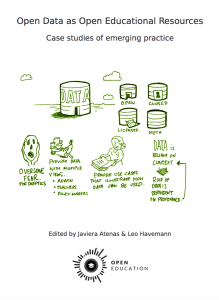
Open Data as Open Educational Resources: Case studies of emerging practice

Original post from: http://education.okfn.org/open-data-as-open-educational-resources-case-studies-of-emerging-practice/

Javiera Atenas and Leo Havemann

This post marks the official publication of the volume: Open Data as Open Educational Resources: Case studies of emerging practice.

The process of developing this book was a learning experience for us. We had no prior experience in independent publishing, but instead of going the traditional route of attempting to find a professional publisher, in the spirit of openness, we decided to self publish, and to make the entire process as open as possible. The intention of this book is to showcase good practices in an approachable way that can be understood by those who are not necessarily very familiar with open data or data analysis, in order to promote the use of open data as OER to educators, researchers and other organisations.

Open Data as Open Educational Resources: Case studies of emerging practice is the outcome of a collective effort that has its origins in the 5th Open Knowledge Open Education Working Group call, in which the idea of using Open Data in schools was mentioned. It occurred to us that Open Data and open educational resources seemed to us almost to exist in separate open worlds.

We decided to seek out evidence in the use of open data as OER, initially by conducting a bibliographical search. As we could not find published evidence, we decided to ask educators if they were in fact, using open data in this way, and wrote a post for this blog (with Ernesto Priego) explaining our perspective, called The 21st Century’s Raw Material: Using Open Data as Open Educational Resources. We ended the post with a link to an exploratory survey, the results of which indicated a need for more awareness of the existence and potential value of Open Data amongst educators.

A couple of months later, we spoke (along with William Hammonds) at the 7th Open Education Working Group Call: Open Data as Open Educational Resources where we ‘set out our stall’ on this topic, and formalised the idea of collecting case studies to be published as an open book for educators. As ever, Marieke Guy did a wonderful job chairing the Working Group call and pushing the conversation forward by raising difficult questions. Meanwhile, we were invited by Antonio Moneo andGeraldine García, to publish our ideas in Spanish in the open knowledge blog of the Inter-American Development Bank.

The majority of the proposals we received were accepted as they fit the themes of the book, and yet each took a different angle on the subject matter. Some other authors who contacted us with with ideas which were not quite right for this project were able to find a home for them here on the OEWG blog instead.

As we started receiving the proposals we also decided to ask a group of experts if they were willing to join us to be part of a scientific committee overseeing the book of case studies, who would act as peer reviewers but, more than that, work alongside the authors and ourselves, towards developing the case studies within an open review model. The experts that joined with us, Marieke Guy, William Hammonds, Anne-Christin Tannhäuser, Maria Perifanou and Ernesto Priego, have a variety of disciplinary backgrounds and work experiences, but all share an interest in open educational practices and were happy to embrace the openness of the project. As soon as they started selecting the cases and working with the authors to develop the drafts, it became clear to us that we had been joined by a group of fantastic people – making the process much easier for all of us – as the authors and reviewers worked seamlessly in a spirit of mutual respect and admiration.

Because of the pivotal role they have played, we wanted to include the voices of the committee members overtly in the book, so we asked each of them for a reflection on both process and product. In her piece, Marieke comments that the result is a set of “detailed and diverse case studies. They are cutting edge tales that show exciting efforts to try out something new, to experiment and to learn from the results”; and for Will, the case studies illustrate the final challenge: “supporting academics and teaching staff to develop their own skills and interests to use open data in this way.”

As we approached the finish line, our friend and colleague Santiago Martín joined us to act as designer. He made a great job of bringing a tonne of files in various different formats into OpenOffice, using an open font, and turning them into this book.

And so last, but certainly not least in the story of this book, we come to the case studies themselves. They have been provided by scholars and practitioners from different disciplines and countries, and they reflect different approaches to the use of open data. The first case study presents an approach to educating both teachers and students in the use of open data for civil monitoring via Scuola di OpenCoesione in Italy, and has been written by Chiara Ciociola and Luigi Reggi. The second case, by Tim Coughlan from the Open University, UK, showcases practical applications in the use of local and contextualised open data for the development of apps. The third case, written by Katie Shamash, Juan Pablo Alperin & Alessandra Bordini from Simon Fraser University, Canada, demonstrates how publishing students can engage, through data analysis, in very current debates around scholarly communications and be encouraged to publish their own findings. The fourth case by Alan Dix from Talis and University of Birmingham, UK, and Geoffrey Ellis from University of Konstanz, Germany, is unique because the data discussed in this case is self-produced, indeed ‘quantified self’ data, which was used with students as material for class discussion and, separately, as source data for another student’s dissertation project. Finally, the fifth case, presented by Virginia Power from University of the West of England, UK, examines strategies to develop data and statistical literacies in future librarians and knowledge managers, aiming to support and extend their theoretical understanding of the concept of the ‘knowledge society’ through the use of Open Data.

We believe the discussions raised by this book are useful in their own right, as wider engagement with, as well as transparency of, public knowledge, are in our view, very worthy aims for education. In addition, we believe that the use of Open Data as OER aids in the development of students’ transversal skills, that is, their literacies, numeracies and digital capabilities, allowing them to think and work as scientists and policy makers, in order to truly operate as global citizens.

This book has been made possible thanks to the support of many people. We would like to thank Paul Bacsich and Elena Stojanovska for supporting the continuation of this project and for their encouragement, and also our fellow OEP advocates at OKFN Edu, OpenEd SIG, OER Research Hub, ELESIG, Open Education Europe, School of Data, ILDA, and finally, our colleagues and friends at UCL and Birkbeck.

The book can be downloaded here Open Data as Open Educational Resources

Open Data as Open Educational Resources: Case studies of emerging practice, edited by Javiera Atenas and Leo Havemann. London: Open Knowledge, Open Education Working Group, 2015. DOI: http://dx.doi.org/10.6084/m9.figshare.1590031

– See more at: http://education.okfn.org/open-data-as-open-educational-resources-case-studies-of-emerging-practice/#sthash.3ymvQNAb.vjWPYZTC.dpuf

Open Coesione School – An example of scalable learning format using OpenData as Educational Resource

from: http://openeducationeuropa.eu/en/node/174400/

The third edition of the open education project “OpenCoesione School” was launched  on the 18th of November 2015. While you are reading this post, about 2800 students and 200 teachers are involved in a collective learning experience focused on civic monitoring public funding through open data analysis, and also  visiting sites, and conducting journalistic research.

OpenCoesione School (or ASOC, from Italian A Scuola di OpenCoesione) is an educational challenge and a MOOC (Massive Online Open Course) designed for students in Italian secondary schools. ASOC was launched in 2013 within the open government strategy on cohesion policy carried out by the National Government, in partnership with the Ministry of Education and the Representation Office of the European Commission in Italy and is also supported by the European Commission’s network of Europe Direct Information Centres.

The objectives of ASOC are to engage participating schools towards actively promoting the use and reuse of open data for the development of civic awareness and engagement with local communities in monitoring the effectiveness of public investment. The participating students and teachers design their research using data from the 900,000 projects hosted on the national OpenCoesione portal in which everyone can find transparent information regarding the  investment on projects funded by Cohesion Policies in Italy as it provides data with detailed information regarding the amount of funding, policy objectives, locations, involved subjects and completion times, so schools can select the data they want to use in their research which can be related with their region or city.  

The programme is designed  in  six main sessions. The first four sessions aim at developing innovative and interdisciplinary skills such as digital literacies and data analysis to understand and critically understand the use of public money. Students learn  through a highly interactive process policy analysis techniques, such as tackling policy rationales for interventions, as well as results and performance. This process employs “civic” monitoring to work on of real cases using data journalism and storytelling techniques.

During the fifth session, and based on the information acquired, the students carry out on-site visits to the public works or services in their territory which are financed  by EU and national funds, and also, interview the key stakeholders involved in the projects’ implementation, the beneficiaries and  other actors. Finally, the sixth session is a final event where students meet with their local communities and policy-makers to discuss their findings, with the ultimate goal to keep the administrators accountable and responsible for their decisions. Here you can find all the video sessions and exercises: http://www.ascuoladiopencoesione.it/lezioni/.

The teaching method combines asynchronous and synchronous learning. The asynchronous model is designed following a  typical of MOOC (Massive Online Open Courses) style where participants learn through a series of activities and teachers are trained by the central ASOC team through a series of webinars. In the synchronous in-class sessions, these share a common structure where each class starts with one or more videos from the MOOC, followed by a group exercise where the participants get involved in teacher-led classroom activities. These activities are organised around the development of the research projects and reproduce a flipped classroom setting.

In between lessons, students work independently to prepare data analysis reports and original final projects. Also, in order to have an impact on local communities and institutions, the students are actively supported by local associations that contribute with specific expertise in the field of open data or on specific topics such as environmental issues, anti-mafia activities, local transportation, etc. Furthermore, the European Commission’s network of information centers “Europe Direct” (EDIC), is involved supporting the activities and disseminating the results. On ASOCs’ website there is a blog dedicated to share and disseminate the students‘ activities on social networks.

ASOC’s pedagogical methodology is centered around specific goals, well-defined roles and decision-making. This has allowed students to independently manage every aspect of their project activities, from the choice of research methods to how to disseminate the results. On the other hand, the teachers are also involved in an intensive community experience that allows them to learn not only from their own students, but also from the local community and from their fellow teaching peers involved in the project.  Ultimately, this takes the form of a collective civic adventure that improves the capacity to form effective social bonds and horizontal ties among the different stakeholders, actors of the local communities. In fact, detailed Open Data on specific public projects has enable new forms of analysis and storytelling focused on real cases developed in the students’ neighborhoods. This, in turn, has the key goal of involving the policymakers in a shared, participatory learning process, to improve both policy accountability and the capacity to respond to local needs.

Finally, ASOC’s key element is that the pedagogical methodology we have developed can be used as a learning pathway that can be adapted to different realities (e.g. different policy domains, from national to local, in different sectors) using different types of open data with comparable level of detail and granularity (e.g. detailed local budget data, performance data, research data, or any other type of data).

If you are interested in learning more from ASOC’s experience, you can read a case study which includes the results of the 2014-2015 edition on Ciociola, C., & Reggi, L. (2015). A Scuola di OpenCoesione: From Open Data to Civic Engagement. In J. Atenas & L. Havemann (Eds.), Open Data As Open Educational Resources: Case Studies of Emerging Practice.

You can also watch ASOC’s documentary video of the 2014-2015 edition here https://vimeo.com/138955671

A Scuola di OpenCoesione 2014-2015: le voci dei protagonisti from OpenCoesione onVimeo.

Don’t hesitate to get in touch with us as we are looking forward to provide support to  your institutions and communities to share what we have learned from this exciting professional journey!!

Chiara Ciociola

Openly licensed new book about OER

A new book about OER has been launched by OECD, the report follows a previous report on OER, and is described by the authors Dominic Orr, Michele Rimini and Dirk Van Damme as „This report follows earlier work by CERI on OER, which resulted in the publication Giving Knowledge for Free in 2007, and an OECD country questionnaire on OER-related policy and activities in 2012. It seeks to provide a state of the art review of evidence on OER practice and impacts, and evaluate the remaining challenges for OER entering the mainstream of educational practice“.

The book is openly licensed and can be accessed via the link in the reference

Orr, D., M. Rimini and D. Van Damme (2015), Open Educational Resources: A Catalyst for Innovation, Educational Research and Innovation, OECD Publishing, Paris. http://dx.doi.org/10.1787/9789264247543-en